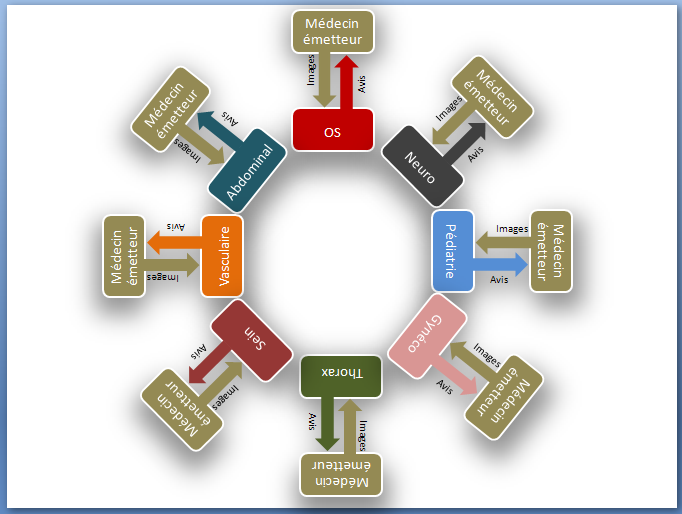
How the network worked
Teleradiology Without Borders was built on a pairing system, the functional unit of the collaborative network.
The reader–emitter pair
Each pair brought together:
- A reader — an experienced radiologist.
- An emitter — a physician, radiologist or not, practising in a developing country.
Digitized cases and a clinical-data form were sent to the reader through the platform.
- Case volume and reading turnaround were set jointly.
- A multi-centre check of the quantity and quality of cases was in place.
- Direct human interaction — collegiality, respect and trust — was encouraged.
Reading groups
Volunteer radiologists from the same institution formed a reading group covering all radiological sub-specialties — for example the “Erasme University Hospital”, “Order of Malta” and “Foundation for Radiology” groups.
Likewise, sub-specialized radiologists from different institutions grouped by discipline: “Paediatric radiology”, “Musculoskeletal radiology”, “Women’s imaging”, “Thoraco-abdominal imaging”.
These groupings enabled mutual support and the sharing of expertise on complex cases.
Secure, professional platform
TWB’s platform was compatible with any internet-connected computer, offering a secure alternative to sending images by email — still widespread at the time.
- Secure transmission and anonymization of radiological cases
- Image storage in DICOM format
- Diagnostic DICOM viewer, CE-marked (medical) and FDA-approved
- Reports linked to each case
 CE markingMedical device